7 Days Return
Without any damage
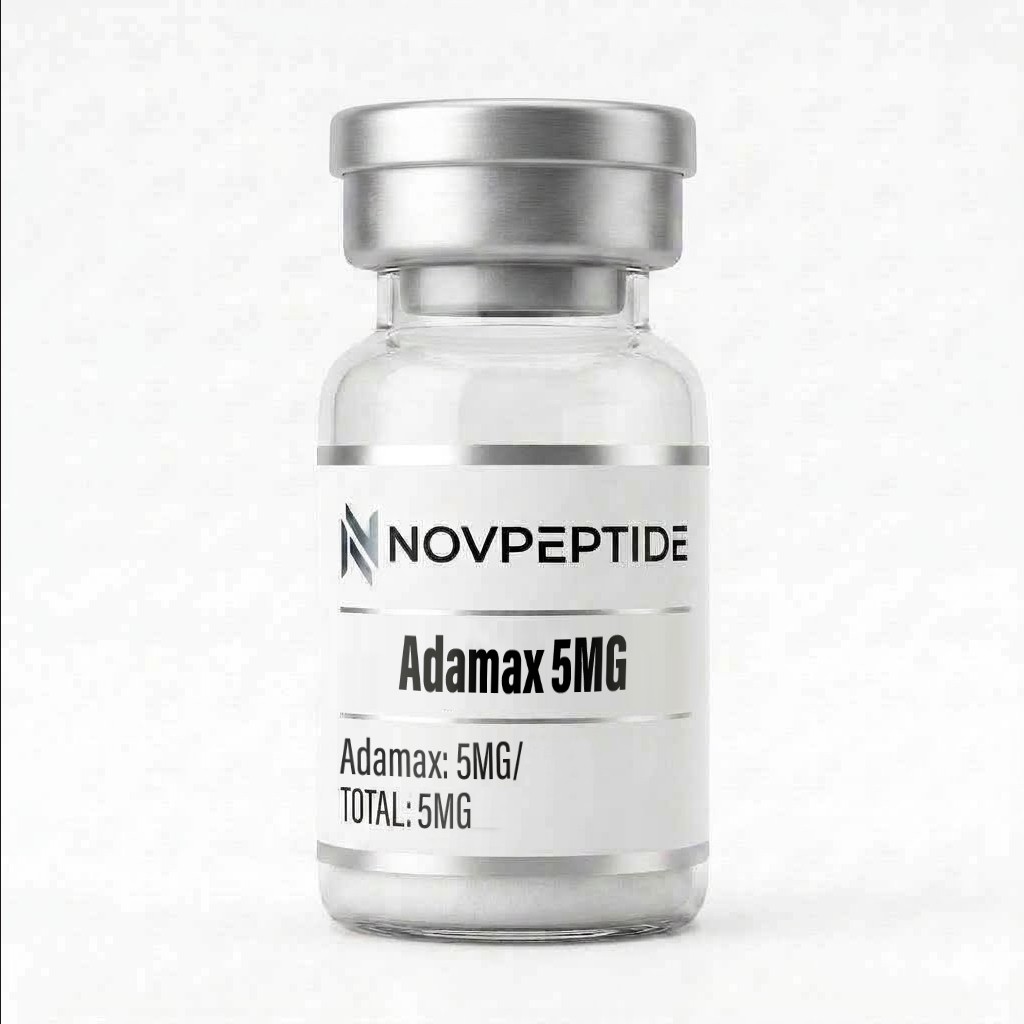
Adamax Peptide: Progress in Scientific Research and Experimental Studies. Adamax is a scientifically modified synthetic neuropeptide, representing an advanced derivative within the SEMAX peptide family. Structurally, Adamax is built upon the foundation of the original SEMAX—a neuroprotective peptide derived from the ACTH 4-10 fragment—but features the addition of an adamantane group at its C-terminus and an acetylation modification at its N-terminus. (1) Research indicates that these unique chemical modifications significantly enhance the peptide's bioavailability, bolster its capacity to traverse the blood-brain barrier (BBB), and endow it with exceptional stability against degradation by endogenous proteolytic enzymes. As a novel nootropic and neuroprotective compound, Adamax primarily targets the central nervous system, exerting its effects by promoting the release of neurotrophic factors and modulating neurotransmitter systems. The development of this peptide class originated from clinical investigations into the treatment of ischemic cerebrovascular diseases; subsequent comparative studies revealed that Adamax demonstrates potential efficacy in cognitive enhancement, memory consolidation, and neuronal protection that is markedly superior to that of traditional SEMAX. (2) Furthermore, experimental models in recent years have demonstrated that Adamax's mechanism of action involves promoting the expression of Brain-Derived Neurotrophic Factor (BDNF) and its receptor, TrkB. The activation of this signaling cascade is not only critical for synaptic plasticity but may also indirectly modulate dopamine levels—specifically by inhibiting the dopamine transporter (DAT)—thereby significantly improving focus, working memory, and tolerance to mental fatigue in animal models, all without inducing peripheral endocrine disturbances. Chemical Composition and Physical Properties—Molecular Structural Features: N-Acetyl-SEMAX-C-Adamantyl (Acetylated SEMAX-Adamantyl). Functional Classification: Nootropic, Neuroprotectant, Neurotrophic Factor Activator. Known Core Targets: BDNF/TrkB Pathway, Melanocortin Receptors (primarily central MC4R), Dopaminergic System. Research and Clinical Trials—Adamax, Neurotrophic Factors (BDNF), and Neuroplasticity: In an experimental study utilizing animal models of central nervous system (CNS) functional degeneration, researchers investigated the potential effects of Adamax on neurotrophic factor expression within the hippocampus and cortex, while also conducting pharmacokinetic analyses. (3) According to the pharmacokinetic analysis report, thanks to the dual protective effects conferred by its acetylation and adamantyl moieties, the biological half-life (T_{1/2}) of Adamax is extended several-fold compared to its parent compound, SEMAX; consequently, its effective therapeutic window within brain tissue is significantly broadened. Preliminary results from this study indicate that continuous exposure to Adamax leads to a significant elevation in BDNF levels in both healthy and impaired animal models. This conclusion is based on observations of brain tissue sections, wherein these changes were quantified—following peptide administration—using specific measurement techniques such as Western blotting and immunohistochemistry (IHC). The results demonstrated a significant enhancement of neurotrophic signaling. Specifically, the researchers noted: "On the 14th day of the experiment, high-resolution imaging and histological assessments revealed statistically significant increases in the mean expression levels of both BDNF protein (up 42.1%; P = 0.01) and Postsynaptic Density Protein-95 (PSD-95; up 28.5%; P = 0.03) within the hippocampal dentate gyrus (DG) region." Furthermore, changes in biomarkers found in serum and cerebrospinal fluid (CSF) suggested that this enhancement of neuroplasticity was accompanied by a marked reduction in markers of neuronal apoptosis, such as Caspase-3. Adamax, Cognitive Function, and Dopamine Regulation: According to a review of multiple neuropharmacological studies, the monoamine neurotransmitters within the central nervous system are frequently in a state of imbalance in experimental models of attention deficits or chronic fatigue. (4) For instance, in mouse models utilized to investigate cognitive dysfunction, the turnover rate of dopamine within the synaptic cleft often appears abnormally accelerated. More specifically, under experimental conditions, acute exposure to Adamax appears to be associated with increased dopamine release and slowed reuptake within the striatum and prefrontal cortex. This suggests that Adamax possesses the potential to enhance dopaminergic neurotransmission—a process believed to be linked to its indirect modulation of central melanocortin receptors. Conversely, chronic low-dose exposure demonstrates significant cognitive-maintenance effects, notably without the receptor downregulation or tolerance typically observed with conventional stimulants. The review further highlights that, in specific models of sleep deprivation, the absence or delayed administration of Adamax leads to a marked decline in learning ability. This decline is attributed to two primary mechanisms: the potential downregulation of synaptic neurotransmitter levels—where the lack of effective psychostimulant input results in the rapid depletion of dopamine and norepinephrine reserves during states of fatigue; and the inhibition of Long-Term Potentiation (LTP) induction—where the absence or insufficiency of Adamax limits the capacity of hippocampal neurons to establish enduring synaptic connections when confronted with cognitive load. Consequently, researchers have administered Adamax in specific models of cognitive impairment, observing that the peptide exerts significant and positive modulatory effects in combating mental fatigue, reducing reaction times, and enhancing the efficiency of complex task processing. (5) Adamax, Neuronal Hypoxia Tolerance, and Antioxidant Capacity: Ongoing scientific research suggests that the potential utility of this peptide may extend beyond its everyday nootropic and cognitive-enhancing properties. (6) The peptide may significantly bolster the survival capabilities of neurons in extreme environments—such as those involving acute hypoxia or ischemia—by preventing oxidative stress and mitochondrial dysfunction within brain tissue. These observations were derived from measurements obtained via Positron Emission Tomography (PET) and Magnetic Resonance Spectroscopy (MRS) in mouse models of cerebral ischemia. More specifically, exposure to Adamax was associated with a significant reduction in cerebral infarct volume and a marked increase in the activity of antioxidant enzymes (such as superoxide dismutase, SOD). This suggests that the peptide may exert its neuroprotective effects by improving the local microenvironment of neurons and conserving energy (ATP). In standardized neurological deficit scoring tests, hypoxia models exposed to Adamax demonstrated a faster recovery of motor coordination; furthermore, their maximum absolute reflex capacity and exploratory behaviors post-hypoxia were significantly superior to those of the control group. Adamax: Synergistic Effects on Peripheral Immunity and Anti-Inflammation. Another study investigated the potential systemic impact of Adamax on the organism within the context of neuroinflammation and autoimmunity. (7) Although Adamax was specifically designed for the central nervous system, studies indicate that it possesses a unique dual effect: on one hand, it crosses the blood-brain barrier to directly block the excessive activation of microglia within the brain, thereby inhibiting the release of central inflammatory cytokines (such as IL-1β and TNF-α); on the other hand, it can modulate systemic immune responses via the peripheral melanocortin system. Microanalysis of cerebrospinal fluid revealed that, in induced neuroinflammation models, the microglia in the Adamax-treated group underwent a distinct phenotypic shift from a pro-inflammatory (M1) state to an anti-inflammatory, reparative (M2) state. Histological analysis suggested that this anti-inflammatory action contributes to the maintenance of myelin integrity in specific models of encephalomyelitis. The researchers noted: "The dual activation of central and peripheral anti-inflammatory pathways by Adamax translated, to some extent, into a resistance to conduction block observed in neuroelectrophysiological tests; specifically, against a background of inflammation-induced axonal injury, the attenuation of action potential amplitude was significantly less pronounced in the Adamax group compared to the placebo control group."